Ski Trip Packing List: What to Wear, What Gear to Bring and What to Rent
For a ski trip, pack three layers for the mountain (thermal base layers, a fleece or light puffy, a waterproof jacket and pants), ski socks, waterproof gloves, a helmet, goggles and a neck gaiter. Add sunscreen and lip balm with SPF, hand warmers, warm clothes and boots for the evenings, a swimsuit for the hot tub, your lift pass and your insurance details. Skis or a snowboard, poles and a helmet are easy to rent at the resort. Boots that fit, goggles, gloves and socks are worth bringing.
The short version: 2 base layer tops and bottoms, 1 or 2 mid layers, ski jacket, ski pants, 3 pairs of ski socks, gloves or mittens plus a spare pair, neck gaiter, beanie, helmet, goggles with a spare lens, sunglasses, sunscreen, SPF lip balm, hand warmers, snow boots, sweaters and jeans for evenings, swimsuit, lift pass or booking, ID, insurance details, chargers. Rent the skis or board and poles unless you own them.
The ski trip packing list, by category
Copy the lists below into your notes or a packing app and cross off what you do not need. They are written for five or six days on snow. Snowboarders pack almost the same bag, and the few differences are marked.
On the mountain: base layers
The layer against your skin moves sweat away so you stay dry and warm.
- Thermal tops, 2 or 3, in merino wool or a synthetic fabric
- Thermal leggings, 2
- Ski or snowboard socks, one pair per day on snow, or 3 pairs if you can dry them overnight
- Sports bras and underwear that dry fast
Leave cotton T-shirts and cotton socks for the evenings. Cotton holds sweat and gets cold on the chairlift. Wear one pair of socks in your boots, not two: a second pair bunches up and makes the boots tighter.
On the mountain: mid layers
- A fleece or a thin wool sweater
- A light insulated jacket or vest, for the coldest days
- A spare mid layer, so one can dry
On the mountain: outer layer
- A waterproof ski jacket, with a pocket for your lift pass
- Waterproof ski pants or bibs
- Waterproof gloves or mittens, plus a spare pair
- Thin liner gloves, for cold days and for using your phone on the lift
- A neck gaiter or balaclava
- A thin beanie or helmet liner
Snowboarders: you sit in the snow to strap in, so waterproof pants matter even more, and many riders like a longer jacket and mittens. Some also wear wrist guards and padded shorts, especially in the first days of learning.
Gear
- Skis and poles, or a snowboard with bindings
- Ski boots or snowboard boots
- A helmet
- Goggles, with a spare lens or a second pair for flat light
- A ski bag or board bag, and a boot bag, if you bring your own gear
- A small backpack, for water, snacks and a spare layer
- A ski lock, if you leave skis outside at lunch
Helmets: the US Consumer Product Safety Commission says that for many recreational activities wearing a helmet can reduce the risk of a severe head injury, and that no helmet design has been proven to prevent concussions. Its helmet chart lists a snow sports helmet for skiing, snowboarding and snow tubing, and tells you to look for a label that says the helmet complies with ASTM F2040 or Snell S-98 or RS-98. A bike helmet is not a substitute: the CPSC notes that helmets designed for other activities may not protect your head as effectively. The fit should be comfortable and snug, level on your head, with the chin strap fastened.
What to rent and what to pack
If you ski a week a year, renting the big items saves a ski bag, an airline fee and the walk through the airport.
| Item | Rent or pack |
|---|---|
| Skis and poles | Rent, unless you own them |
| Snowboard | Rent, unless you own one |
| Boots | Pack if you own a pair that fits |
| Helmet | Rent, or pack your own |
| Goggles | Pack |
| Gloves and socks | Pack |
| Jacket and pants | Pack |
Boots are the item to own first, because fit decides how your day goes. If you rent, reserve online before the trip: the shop sets your gear aside, and you can pick it up the afternoon you arrive, not in the first morning's line. Many rental shops also rent helmets, and some rent jackets and pants, so ask before you buy outerwear for a first trip.
Off the mountain
- Sweaters or hoodies, 2 or 3
- Jeans or warm pants, 2 pairs
- T-shirts or long-sleeved tops, one per evening
- Underwear and everyday socks, one per day plus a spare
- Pajamas
- A warm coat, or wear your ski jacket in the evenings
- Waterproof snow boots with good grip, for icy sidewalks and parking lots
- Slippers or thick socks for the cabin or condo
- A swimsuit and flip-flops, for the hot tub, pool or sauna
- One nicer outfit, if you have a dinner booked
Evening clothes are where people overpack. You spend most of the day in ski clothes, so two or three sets of evening clothes cover a week.
Toiletries and sun protection
- Broad spectrum sunscreen, SPF 15 or higher, in a pocket size for the mountain
- Lip balm with SPF
- Moisturizer and hand cream, since mountain air is dry
- Sunglasses, for lunch on the terrace and for the drive
- Toothbrush, toothpaste, deodorant, shampoo and the rest of your usual kit
- Blister plasters
- Pain relievers and any prescription medicines, with a few extra days
Snow and altitude both raise the dose of sun you get. The World Health Organization says UV levels increase by approximately 10 percent with every 1,000 m (about 3,300 ft) of altitude, and that fresh snow almost doubles a person's UV exposure by reflecting it back at you. The same page points to snow blindness in skiers as the reason eye protection has to account for reflection from the ground, which is the case for goggles or sunglasses on every day out, cloudy ones too.
For the sunscreen itself, the FDA recommends broad spectrum sunscreen with an SPF of 15 or higher, reapplied at least every two hours. Its list of frequently forgotten spots reads like a list of what a helmet and goggles leave uncovered: ears, nose, lips (use SPF lip balm) and the back of the neck.
Electronics
- Phone and charger
- A power bank, for long days of photos and trail maps
- Headphones
- An action camera with a spare battery, if you use one
- Heated socks, gloves or boot heaters and their chargers, if you own them
- A plug adapter for trips abroad
Skiing in the Alps, Japan or Canada? Sockets differ: France, Austria and Switzerland use round-pin plugs at 230 V, while Canada and Japan take US-style Type A and B plugs. Our guide to which plug you need by country has the table.
Documents and money
- ID or passport
- Lift pass, season pass or the booking confirmation for your lift tickets
- Rental and lesson confirmations
- Travel insurance details, with the emergency phone number
- Health insurance card
- Credit cards and a little cash
- Driver's license, if you rent a car
Read your travel insurance before you go. Not every policy covers skiing and snowboarding, and off-piste or backcountry skiing can be treated differently from marked runs. Save the policy number and the emergency number in your phone and write them on paper in your jacket.
Small essentials people forget
These are small, cheap at home and expensive at the base lodge.
- Sunscreen and SPF lip balm, in the jacket pocket, not the suitcase.
- A spare goggle lens for flat light, or a second pair of goggles.
- Hand warmers and toe warmers.
- The lift pass. If your resort uses a reloadable card, bring last year's card.
- Insurance details, on your phone and on paper.
- A spare pair of gloves, for the day the first pair is still wet.
- A neck gaiter.
- A water bottle and snacks for the lift.
- Tissues, for the runny nose every skier gets.
- A boot dryer or newspaper to stuff in wet boots overnight.
- Zip bags, to keep a phone and a wallet dry.
The everyday items that get left behind on any trip, from chargers to medicines, are in our list of commonly forgotten items.
Going high? Plan an easy first day
Many ski resorts sit high enough to notice. The CDC's travel health guide lists Colorado ski resorts such as Vail and Breckenridge, with lodgings at 8,150 and 9,600 ft (2,480 and 2,925 m), among popular high-altitude destinations, and says any traveler who is not acclimatized and sleeps at 8,000 ft (2,450 m) or higher is at risk for altitude illness. Headache is the main symptom, usually with fatigue, dizziness, nausea or loss of appetite.
The CDC's advice for the first 48 hours at altitude is to avoid alcohol and do only mild exercise. For a ski week, that means an easy first day and saving the big night out for later. If you have had altitude problems before or have a heart or lung condition, talk to your doctor before the trip.
Flying with skis or a boot bag
Rules come from two places: airport security decides what can go in the cabin, and your airline decides what a ski bag costs.
Security (US):
- TSA lists ski poles as checked bags only.
- Snowboards are allowed by TSA in carry-on and checked bags, with a note to check with your airline for size and weight restrictions. In practice a board goes in the hold.
- Helmets and hand warmers are allowed in both carry-on and checked bags.
- Snow cleats for your boots go in checked bags only.
Airlines: many airlines treat a ski or snowboard bag and a boot bag as one checked item, with conditions. Two examples:
- Southwest says up to two bags count as one item, even if they are packed and tagged separately: one with the skis or snowboard, one with the boots. Each bag must weigh 50 pounds or less to avoid an overweight fee.
- Air Canada says one boot bag per passenger does not count as a piece of checked baggage if it travels with skis or a snowboard and holds only ski or snowboard equipment, such as boots, a helmet and goggles. A boot bag with other things in it counts as a separate bag.
So do not fill the boot bag with clothes until you have read your own airline's page, and weigh both bags at home. Fees and limits differ by airline and fare.
Batteries in heated gear: heated socks, gloves, jackets and boot heaters run on lithium batteries. TSA's entry for heated jackets points to the FAA's battery rules, and the FAA says spare lithium batteries and power banks must be carried in carry-on baggage only. The simple routine: take the battery packs out of the heated gear, protect the terminals, and keep them with your power bank in your cabin bag. If a carry-on is checked at the gate, take the batteries out first.
Boots in the cabin: many skiers carry their boots on and check the rest. If a ski bag is delayed, skis are easy to rent for a day. Boots that fit your feet are not. Our carry-on packing list covers what else belongs in the cabin bag.
The short list for a ski weekend
For two days on snow, cut the clothes and keep the gear.
- Base layers: 1 top and 1 bottom, plus a spare top
- 1 mid layer
- Ski jacket and pants (wear the jacket to travel)
- 2 pairs of ski socks
- Gloves, neck gaiter, beanie
- Helmet and goggles
- Sunscreen, SPF lip balm, hand warmers
- 1 evening outfit, pajamas, underwear and socks for 2 days
- Snow boots (wear them to travel)
- Swimsuit
- Toiletries and medicines
- Phone charger and power bank
- Lift tickets, rental booking, ID and insurance details
For the non-ski half of the bag, our weekend trip packing list has the counts for two and three nights. Spending the holidays at a ski house with relatives? Add the gifts and houseguest items from the holiday packing list.
Build the ski list in Luggy
A ski list is long, it mixes clothes with gear and paperwork, and you need the same list again next winter. Luggy is a packing list app for iPhone that keeps it as one trip, with a name, destination and dates, and the list grouped by category.
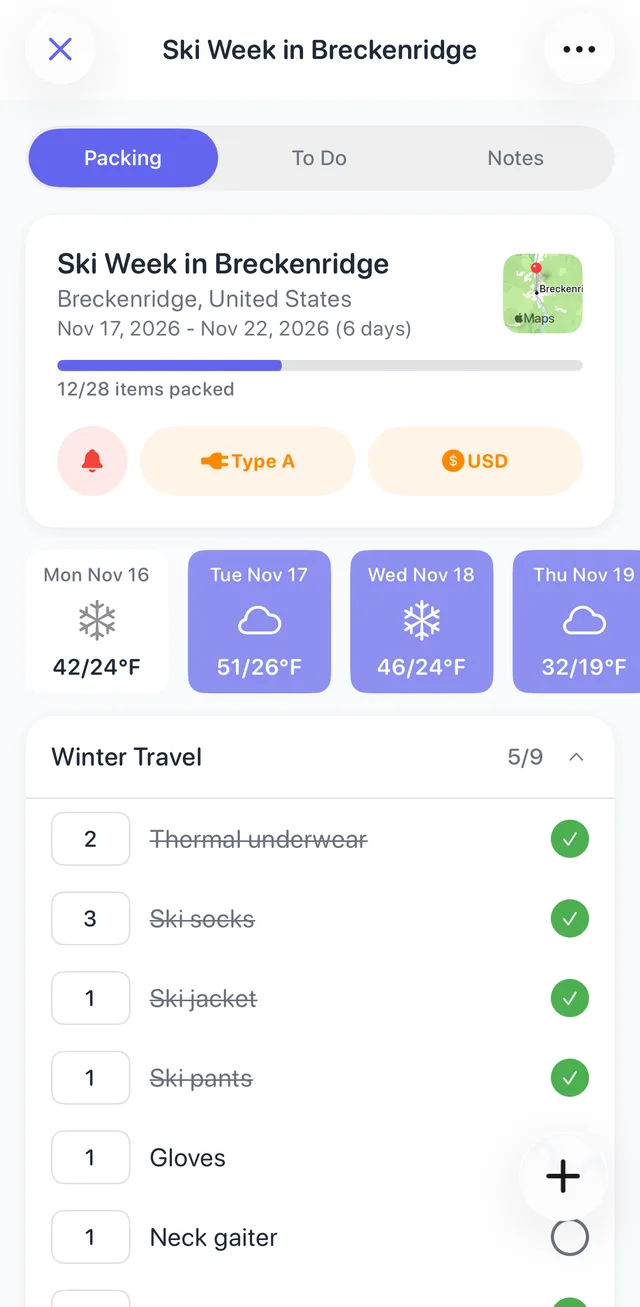
Luggy does not write the list for you: you pick what goes on it. You add items from a ready-made list of 258 items in 25 categories, or type your own. The built-in Winter Travel category covers the cold-weather basics: winter coat, thermal underwear, gloves, beanie, scarf, wool socks, winter boots, hand warmers and lip balm. You set a quantity for each item, like 3 pairs of ski socks or 6 hand warmers, and check things off as they go in the bag.
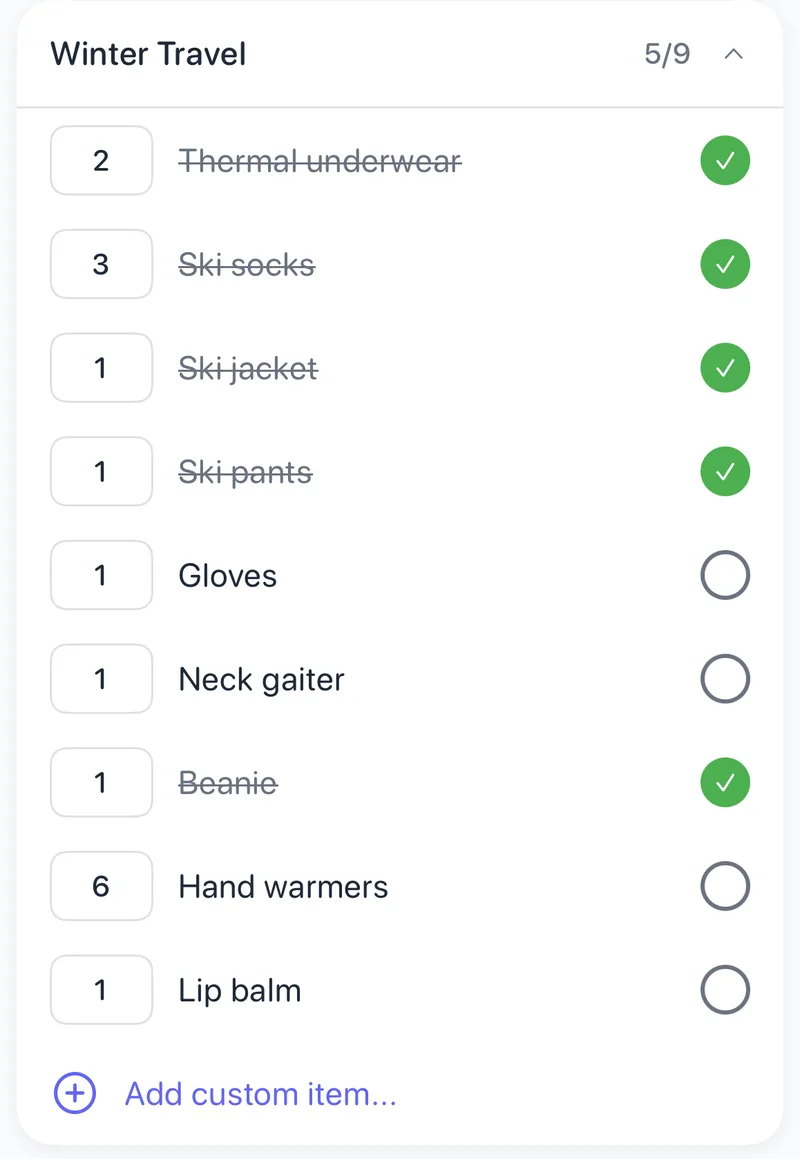
There is no built-in ski or snowboard category. Type the gear in as your own items with the Add custom item row at the bottom of a category, for example the helmet, goggles and boots under the built-in Sports Equipment category. If you plan to rent something, say so in the item name, so the list still reminds you to book it.
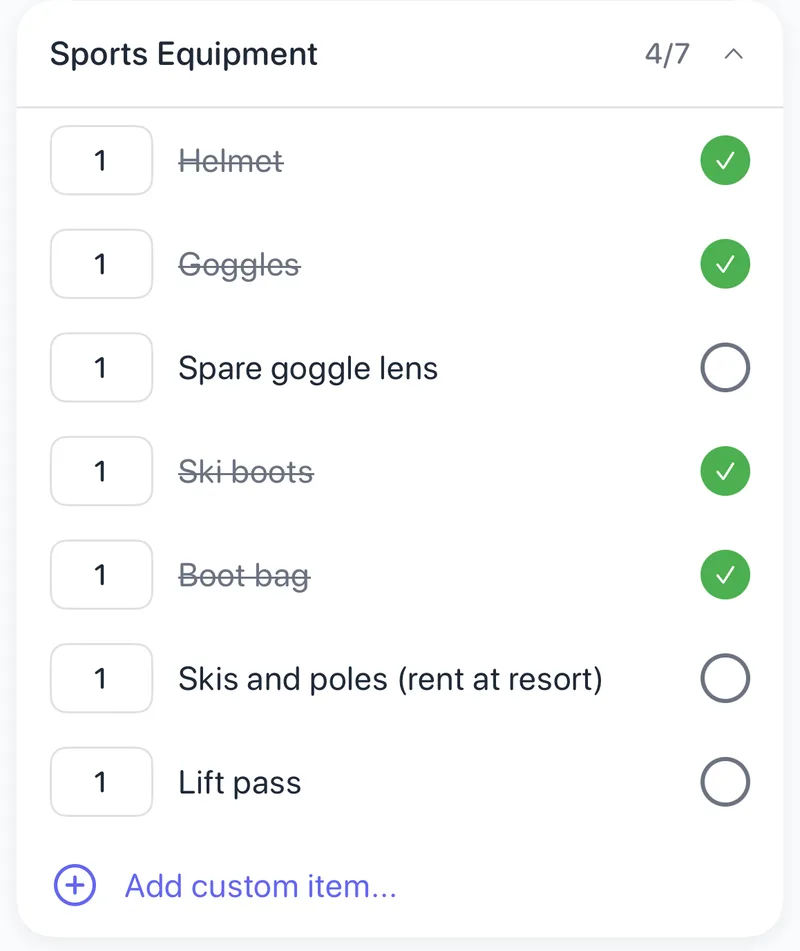
The weather forecast on the trip screen covers the next several days, so it helps in the last days before you leave, when you decide between the thin and the thick mid layer. For a trip abroad, the same screen shows the destination's plug type and currency.
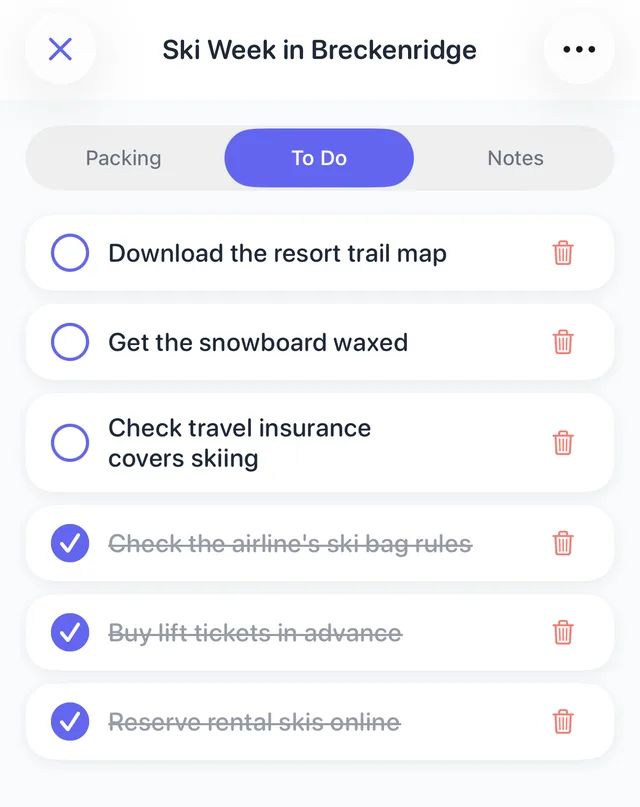
Each trip also has a to-do list for the jobs that are not things to pack, like reserving rentals or reading the airline's ski bag rules.
Luggy is free to download. The free version covers one trip with the packing list, quantities, check-offs, your own items, a to-do list, notes and the destination's weather, plug type and currency. Luggy+ adds unlimited trips, custom categories (so the gear can have its own Ski Gear category), reusable custom lists, copying a past trip for next winter, packing reminders and PDF export. If you would like to compare it with Notes and Reminders first, see how to make a packing list on iPhone.
Luggy: packing list app
Build a packing list for each trip from 250+ ready-made items in 25 categories, check things off as you pack, keep a pre-trip to-do list, and see your destination's plug type, currency and weather. Free to download.

Last check before you leave
- Boots, yours or the rental booking.
- Helmet, goggles and gloves.
- Lift pass or ticket confirmation, ID and insurance details.
- Sunscreen and SPF lip balm, in the jacket pocket.
- Batteries and power bank in the cabin bag, if you fly.
- The forecast for the resort, for the last layer decision.
Common questions
What should I pack for a ski trip?
Base layers, a mid layer, a waterproof jacket and pants, ski socks, gloves, a neck gaiter, a helmet, goggles, sunscreen and SPF lip balm, hand warmers, warm evening clothes, snow boots, a swimsuit, your lift pass, ID and insurance details. Bring or rent skis or a snowboard, poles and boots.
What should I rent for a ski trip?
Skis and poles or a snowboard are the easy items to rent, and most rental shops rent helmets too. If you own boots that fit, bring them. Pack your own goggles, gloves, socks and base layers.
Can you bring ski boots or a helmet on a plane?
TSA allows helmets in carry-on and checked bags. Ski poles must be checked. Whether a boot bag fits in the cabin depends on your airline's carry-on size limit, so check it before you fly. Many airlines count a ski bag and a boot bag together as one checked item.
What do snowboarders pack differently?
A snowboard with bindings and snowboard boots, no poles. Many riders also choose mittens, a longer jacket, and wrist guards or padded shorts while they learn. Everything else on the list is the same.