Commonly Forgotten Items When Packing (and How to Stop Forgetting Them)
The things people forget when packing are rarely random. They are the phone charger still plugged in by the bed, the toothbrush you used that morning, the medicine in the kitchen cabinet and the ID in a different wallet. They get left behind because you are still using them, or because they live somewhere other than your suitcase.
The short version: the usual suspects are chargers and cables, everyday toiletries, glasses or contact lenses, medicines, pajamas, your ID or passport, and things you only need when you arrive, like a plug adapter or a rain jacket. Keep one packing list you reuse, check items off as they go into the bag, keep a short "last morning" list for the things you are still using, and do a two-minute walk through the house before you leave.
You will see "most forgotten items" rankings online. Most come from polls run by travel or retail companies, so treat any percentages with care. What is useful is the pattern: forgotten items fall into a few groups, and each group has a simple fix.
| Why it gets forgotten | Typical items |
|---|---|
| You use it every day at home | Toothbrush, razor, glasses, contacts, pajamas |
| It stays plugged in | Phone charger, cables, watch charger, power bank |
| It lives somewhere else | Medicines, ID, passport, cards |
| You only need it on arrival | Plug adapter, rain jacket, swimsuit, house keys |
Things you use every day at home
These are easy to miss, because you cannot pack them until the last morning. By then you are rushing.
- Toothbrush and toothpaste
- Razor and deodorant
- Glasses, sunglasses, contact lenses and lens solution
- Hairbrush, hair ties, skincare
- Pajamas
- Your pillow or sleep mask, if you travel with one
The fix: make a short "last morning" list of exactly these items and put it on top of your bag or on your phone. Pack a spare toothbrush and travel-size basics that live in your toiletry bag full time, so the only things left for the morning are the ones you truly use daily.
If you fly from the US with only a carry-on, liquids, gels and creams go in a quart-sized bag, in travel-sized containers of 3.4 ounces (100 ml) or less. A full-size bottle that ends up in your carry-on by mistake will not make it through screening.
Chargers and cables left in the wall
Chargers are easy to forget, both on the way out and on the way home. They stay plugged in until the last minute, often behind a bed or a desk.
- Phone charger and cable
- Watch, earbuds and laptop chargers
- Power bank
- Plug adapter for international trips
The fix: charge everything the night before, then pack the chargers that evening, not in the morning. Use a power bank or your laptop to top up your phone on the travel day. On the way home, check every outlet in the hotel room before you leave.
Power banks go in your carry-on. The FAA says spare lithium batteries, including power banks, must be carried in carry-on baggage only, and must come out of your bag and stay with you in the cabin if the bag is checked at the gate. Some airlines also limit how many power banks you can bring.
For trips abroad, find out which plug your destination uses before you go: our guide to which plug you need covers more than 40 countries.
Medicines
Medicines live in the kitchen or bathroom cabinet, not with your travel things, so they are easy to miss. They are also the hardest item to replace in another country.
The CDC's advice on traveling abroad with medicine:
- Pack medicines in your carry-on, in case your checked bag is lost or delayed.
- Keep them in their original, labeled containers.
- Bring enough for the whole trip, plus extra in case of travel delays.
- Carry copies of your written prescriptions, including the generic names, and leave a copy with someone at home.
- Check that your medicines are allowed in your destination, and in any country where you have a layover, because each country has its own laws on medicines.
Its Pack Smart list also suggests copies of prescriptions for glasses and medical supplies, and spare glasses or contacts.
At US airports, TSA allows larger amounts of medically necessary liquids in reasonable quantities for your flight, but you must declare them to the officers at the checkpoint.
The fix: put "medicines" on your list as its own category, with each medicine by name, not one line that says "meds". Refill prescriptions a week or two before you leave.
Documents, ID and cards
This group is the most serious. A forgotten toothbrush costs a few dollars. A forgotten passport can cost you the trip.
- Passport, and visa if you need one
- Driver's license or other ID, especially if you plan to rent a car
- Credit and debit cards, plus a backup card kept in a different bag
- Health insurance card and travel insurance details
- Copies of your passport and travel documents
For domestic flights in the US, you now need a REAL ID-compliant license or another accepted ID such as a passport: TSA says REAL ID enforcement began on May 7, 2025. If your license is not REAL ID-compliant, bring your passport.
For trips abroad, check your passport's expiry date well before you pack, because many countries want it to be valid for some time after you leave. The EU, for example, asks visitors from outside the EU for a passport valid for at least 3 months after the date you intend to leave and issued within the last 10 years. The CDC's Pack Smart list suggests bringing copies of your passport and travel documents, a contact card for someone at home and your insurance documents, ideally both printed and on your phone.
The fix: keep documents in one travel pouch that never gets unpacked between trips, and check it at the door. Our before traveling checklist covers the paperwork to sort out weeks ahead.
Things you only need when you arrive
Nobody thinks about these while packing, because you will not need them until you land.
- Plug adapter
- Rain jacket or umbrella
- Swimsuit
- Comfortable walking shoes
- Your house keys, for the trip home
- The address of where you are staying, saved offline
- A pen, if you need to fill in an arrival form on paper
The fix: before you pack, picture your first day there: the walk from the airport, the hotel check-in, the first evening out. Anything you would reach for goes on the list. Check the forecast a few days before you leave and add rain or warm layers.
A routine that stops the forgetting
Lists of forgotten items help once. A routine helps every trip.
- Keep one master list and reuse it. Start from a full list like our international travel packing list, cut it to how you travel, and keep it. Every time you forget something, add it to the master list so it never happens twice.
- Pack by category. Documents, electronics, toiletries, medicines, clothes. Categories make gaps obvious: an electronics section with no charger stands out.
- Check items off as they go into the bag, not when you think of them. "I'll grab it later" is how things get left behind.
- Set a reminder to start packing. Packing the evening before, not the morning of, leaves only the last-morning items for the travel day.
- Keep a last-morning list. Toothbrush, glasses, chargers, medicines, pajamas. Five or six items, checked right before you zip the bag.
- Do a two-minute walk. Bathroom, bedside table, every outlet, the kitchen cabinet with your medicines, the hook where your keys hang.
- Check at the door: phone, wallet, keys, ID or passport.
- Repeat on the way home. Check the outlets, the bathroom, the safe and under the bed in your room.
How Luggy helps you stop forgetting
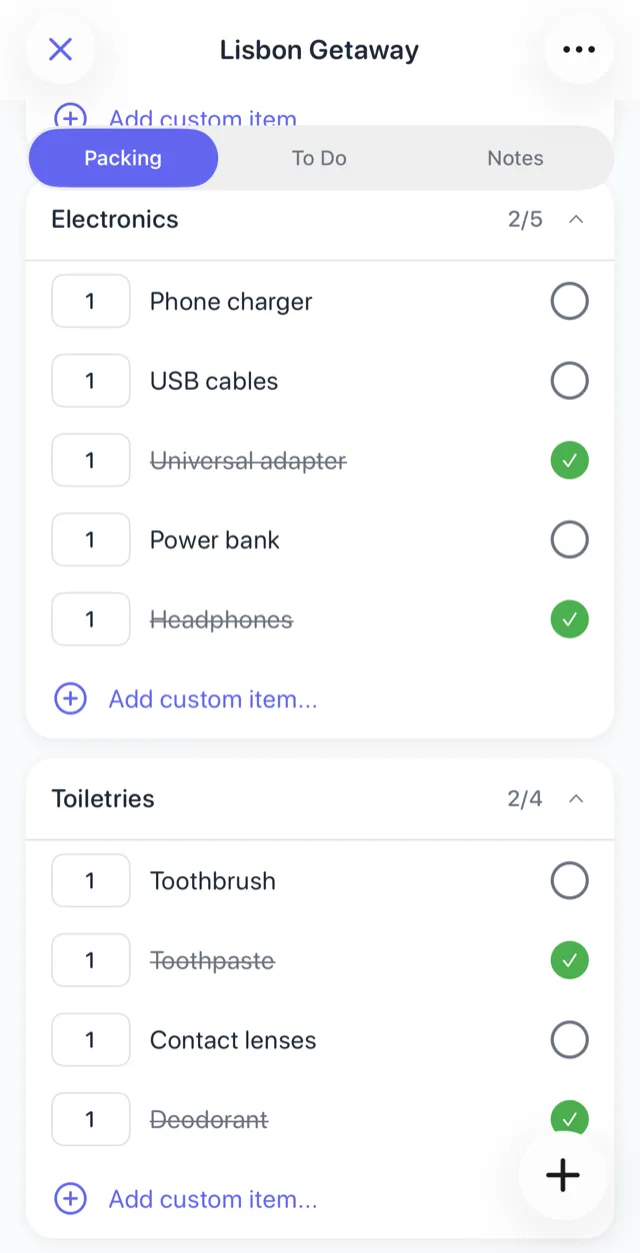
Luggy is a packing list app built around this routine. Each trip has a packing list grouped by category, which you build from a ready-made list of 258 items in 25 categories or with your own items. You check items off as you pack, and the trip shows how many items are packed so far.
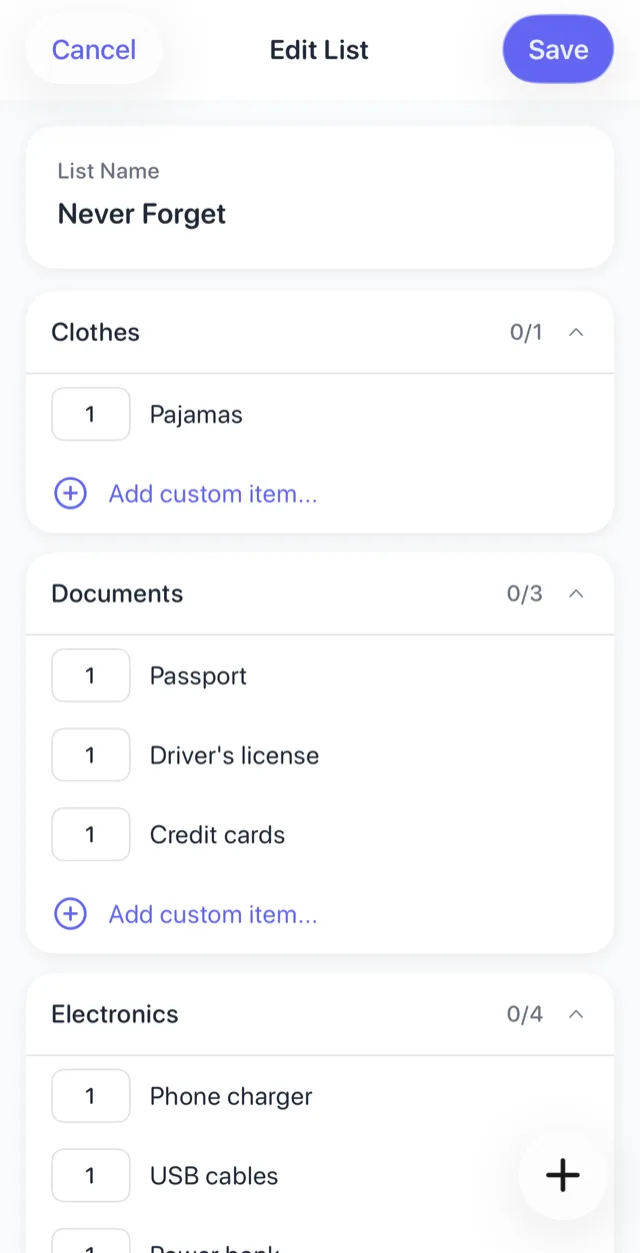
With Luggy+, you can save your master list as a reusable custom list, like the "Never Forget" list below, and apply it to a new trip. Applying a custom list replaces the trip's current items, so do it first, then add what is specific to that trip.
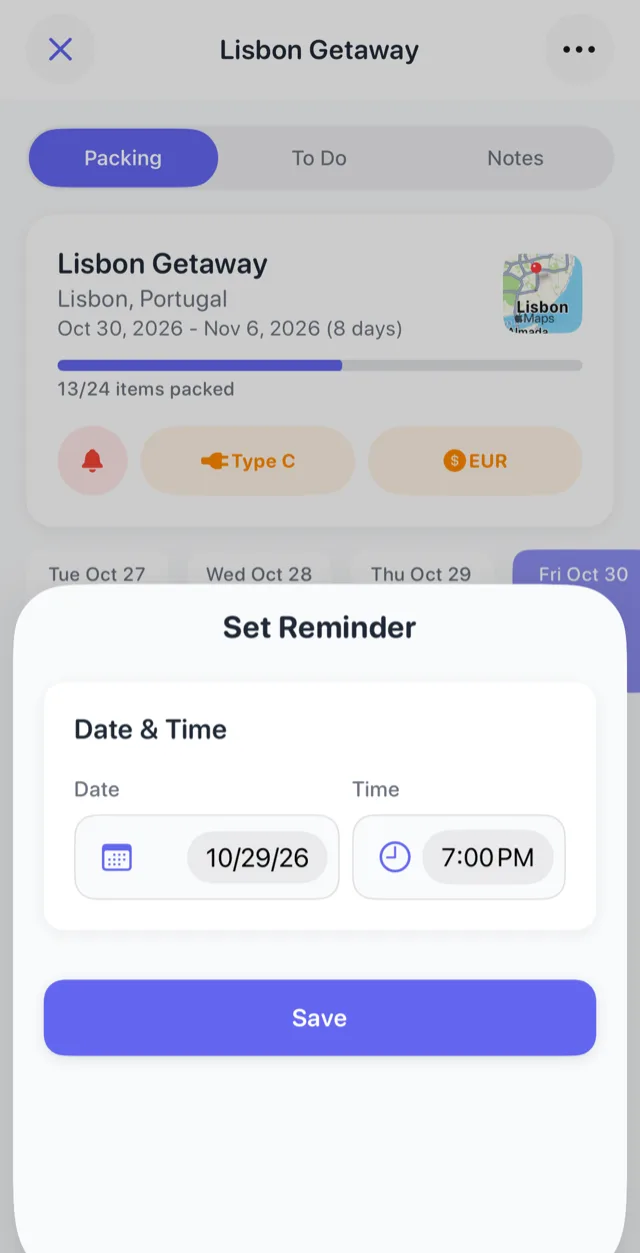
Luggy+ also adds a packing reminder: you pick a date and time, and Luggy sends a notification that your trip is coming up and it is time to start packing.
Luggy is free to download, and the free version covers one trip with the packing list, check-offs, quantities, your own items and a to-do list. Luggy+ adds unlimited trips, copying a past trip (with every item unchecked again), custom lists, packing reminders and PDF export.
Luggy: packing list app
Build a packing list for each trip from 250+ ready-made items in 25 categories, check things off as you pack, keep a pre-trip to-do list, and see your destination's plug type, currency and weather. Free to download.

Common questions
What are the most common things to forget when packing?
There is no official ranking, but the same groups come up again and again: chargers and cables, everyday toiletries like toothbrushes and razors, glasses and contact lenses, medicines, pajamas, ID or passport, and things you need on arrival, like a plug adapter or rain jacket.
How do I stop forgetting things when I pack?
Use the same packing list for every trip, pack by category, check items off as they go in the bag, keep a short last-morning list for things you are still using, and walk through the house before you leave. Add anything you forget to your list so it does not happen again.
What should I check before leaving the house for a trip?
Phone, wallet, keys and your ID or passport at the door. Before that, check the bathroom, the bedside table, every outlet for chargers and the cabinet where you keep your medicines.
What should I check in a hotel room before checking out?
Start with the chargers in the wall. Then look at every outlet, the bathroom counter and shower, the room safe, the closet and under the bed.