Before Traveling Checklist: 20 Things to Do Before an International Trip
Most of what goes wrong on an international trip starts at home: a passport that expires too soon, a visa nobody checked, a bank card that gets blocked on the first day. Here are 20 things to do before you go, in the order to do them.
The short version: as soon as you book, check your passport, visa rules and travel insurance. Four to six weeks out, see a doctor about vaccines and medicines and sign up for embassy alerts. Two weeks out, sort out your bank, phone and home. In the last week, check the forecast and download what you need offline. The night before, pack your carry-on and do one last walk through the house.
| When | What to do |
|---|---|
| As soon as you book | Passport, visa, travel advice, insurance, driving permit, papers for kids |
| 4 to 6 weeks out | Health appointment, medicines, STEP or FCDO alerts, plug adapter |
| 2 weeks out | Bank and cards, phone plan, document copies, home and pets, packing list |
| The last week | Forecast, offline maps, check-in |
| The night before | Carry-on, chargers, home check |
As soon as you book (2 to 3 months out)
These are the jobs that take the longest to fix, so they come first.
1. Check your passport's expiry date
Do it the day you start planning. The US State Department's international travel checklist notes that some countries, especially in Europe, want your passport to be valid for at least 6 more months after your travel dates, and that passports for children under 16 are only valid for 5 years.
If you need a new one, apply early. At the time of writing, the State Department's processing times page lists 4 to 6 weeks for routine processing and 2 to 3 weeks for expedited, and it adds up to 2 weeks for your application to reach them and up to 2 weeks for the passport to reach you. Those times change with demand, so check the page before you book. It also says the busiest season runs from late winter to summer.
2. Check whether you need a visa or travel authorization
Some countries want a visa or an electronic travel authorization before you fly. The State Department suggests checking with your destination's embassy and the entry requirements in its travel guidance for that country. If you live in the UK, the FCDO's foreign travel checklist points to its travel advice pages for each country, which include entry requirements.
3. Read the travel advice for your destination
Look up the travel advisory for the country while you can still change plans. The State Department checklist starts here: review the travel advisory and local requirements for where you are going.
4. Buy travel insurance
The State Department is direct about this: the US government does not pay medical bills abroad, and US health insurance, including Medicare and Medicaid, usually does not cover care abroad. It recommends considering travel medical insurance that covers emergency care and medical evacuation. The UK's checklist says to get travel insurance as soon as you book, and notes that a GHIC or EHIC card does not replace it.
5. Check your driver's license if you plan to drive
Many countries do not accept a US driver's license on its own, and you may need an International Driving Permit. The UK checklist gives the same advice for UK licenses. Sort this out before you book a rental car.
6. Get the paperwork for kids traveling without both parents
If a child travels without one or both parents, the State Department says you may need custody papers or a notarized letter of permission from the other parent, even when one parent is on the trip. Check the entry rules for your destination.
4 to 6 weeks out
7. Book a travel health appointment
The CDC recommends seeing your doctor or a travel health specialist at least 4 to 6 weeks before you leave, to get up to date on routine vaccines and ask about vaccines and medicines for your destination. Its destination pages list the health information for each country.
8. Check and refill your medicines
Some prescription and over-the-counter medicines that are legal in the US are not legal in other countries, according to the State Department, so check your destination's rules. Bring copies of your prescriptions and keep medicines in labeled bottles. The CDC suggests packing enough for the whole trip, plus extra in case of delays, so refill early.
9. Sign up for embassy alerts
If you are a US citizen, enroll in the Smart Traveler Enrollment Program (STEP). It is free, it sends you security, health and weather alerts from the US embassy for your destination by email, and it helps the embassy reach you or your emergency contact in an emergency. UK travelers can sign up for the FCDO's travel advice email alerts on GOV.UK.
10. Buy the right plug adapter
Look up the plug type and voltage for your destination now, so you can order an adapter and check your chargers in time. Our guide to which plug you need covers more than 40 countries.
2 weeks out
11. Sort out your bank and cards
Tell your bank and card providers your travel dates if they ask for that, check what they charge for foreign transactions and cash withdrawals, and bring a backup card that you keep in a different bag. The UK checklist puts it simply: make sure you can get to enough money if your main card stops working. Look up the local currency and roughly what it is worth.
12. Decide on your phone plan
Pick roaming, an eSIM or a local SIM before you leave, so your maps and messages work the moment you land. Check what your carrier charges for roaming first.
13. Make copies of your documents
The State Department suggests making several copies of your travel documents: give one set to a trusted friend or family member, keep one set with you but apart from the originals, and take photos of them on your phone. That makes a lost passport much easier to replace.
14. Arrange things at home
Ask someone to collect the mail or pause deliveries, book a pet sitter or kennel, and leave a key with a neighbor. Tell one person at home your travel dates and where you are staying.
15. Start your packing list
Two weeks is enough time to buy what is missing without rushing. Use our international travel packing list as a starting point and cut it down to your trip.
The last week
16. Check the weather forecast
Look at the forecast for your destination a few days before you leave and adjust the warm layers and rain gear.
17. Download what you need offline
Save offline maps of the cities you are visiting, your airline's app and boarding pass, a translation app, and the addresses of where you are staying.
18. Confirm your bookings and check in
Reconfirm your flights and accommodation, and check in online as soon as your airline opens check-in.
The night before
19. Pack your carry-on
Keep your passport, cards, medicines, phone, chargers and a change of clothes with you. Power banks always go in the cabin: the FAA says spare lithium batteries, including power banks, must be carried in carry-on baggage only. Flying from the US, liquids, gels and creams in your carry-on go in a quart-sized bag, in containers of 3.4 ounces (100 ml) or less, with exemptions for medications.
20. Do a last check of the house and your bag
Charge your phone and power bank, empty the fridge of anything that will spoil, take out the trash, lock the windows and put your passport by the door. Then go through your packing list one last time.
Keep the countdown with your trip in Luggy
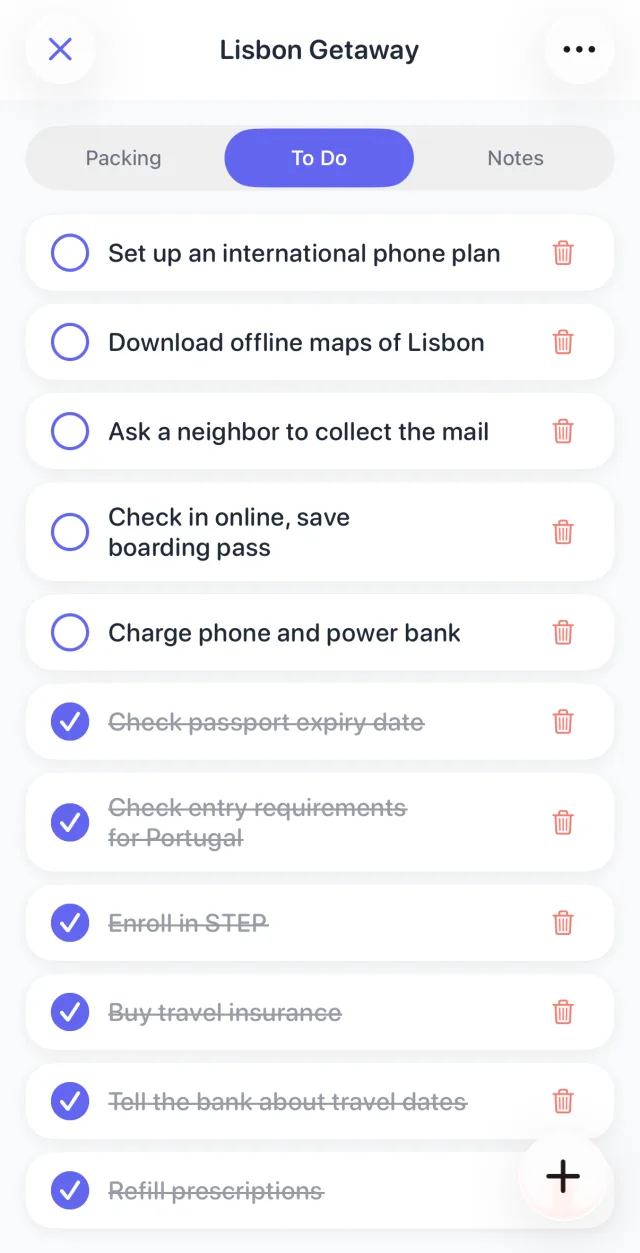
A countdown like this only works if you can see it. In Luggy, every trip has a To Do tab next to its packing list. You write the tasks yourself, so you can copy the 20 steps above, or only the ones that apply, and check them off as you go.
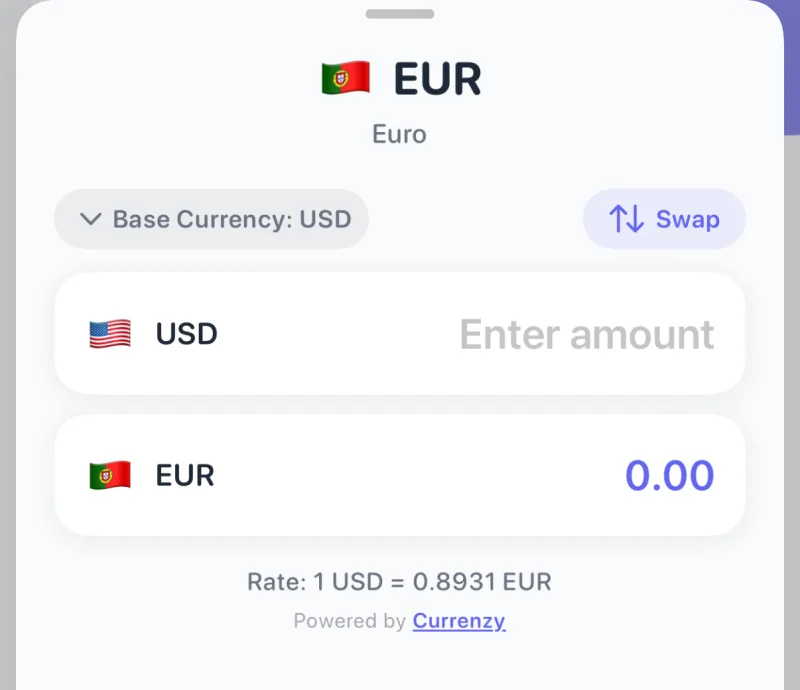
The trip screen also shows the destination's currency with an exchange-rate converter, which helps with the money step.
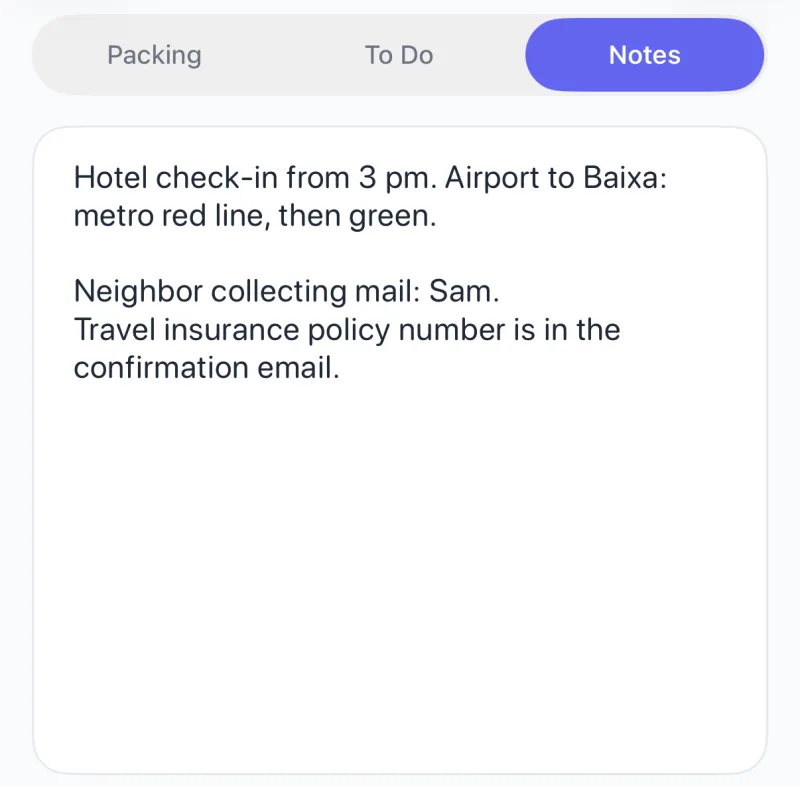
The Notes tab holds the details you want to find quickly on arrival: the check-in time, how to get from the airport, who is collecting the mail.
Luggy is free to download and the free version covers one trip at a time, with the packing list, to-do list, notes and destination info. Luggy+ adds unlimited trips, copying a past trip, packing reminders at a time you pick, reusable custom lists and PDF export of the packing and to-do lists.
Luggy: packing list app
Build a packing list for each trip from 250+ ready-made items in 25 categories, check things off as you pack, keep a pre-trip to-do list, and see your destination's plug type, currency and weather. Free to download.

Common questions
What should I do before traveling internationally?
Check your passport's expiry date and the visa rules first, then buy travel insurance, see a doctor about vaccines and medicines 4 to 6 weeks out, sign up for embassy alerts, and sort out your bank, phone plan and plug adapter. The countdown above puts all 20 steps in order.
How early should I renew my passport before a trip?
As early as you can. Processing alone takes weeks, and the State Department adds up to 2 weeks of mailing time each way. Check its processing times page before you book, because the times change with demand.
Do I need to tell my bank I'm traveling?
Ask your bank whether it wants your travel dates. Either way, bring a backup card and know what your cards charge abroad.
What should I do the night before an international trip?
Pack your carry-on with your passport, cards, medicines, chargers and power bank, charge your devices, check your bookings, and do a last walk through the house before bed.