What Plug Do I Need? Travel Adapters by Country
You need an adapter that matches the plug type your destination uses: Type G for the UK and Ireland, Type C or F for most of continental Europe, Type I for Australia and New Zealand. Canada, Mexico and much of the Caribbean use the same Type A and B plugs as the US, and so does Japan. Find your destination in the table below.
The short version: an adapter changes the plug shape. It does not change the voltage. Many phone, tablet and laptop chargers accept 100 to 240 volts, so an adapter is all they need. Check the label: if it says "100-240V", you are fine. Single-voltage appliances, like some hair dryers and straighteners, need a converter or should stay at home.
The plug types, voltages and frequencies below come from the International Electrotechnical Commission's World Plugs guide (IEC, the body that writes international electrical standards; the guide has since been retired, so the link is the archived copy).
Plug types and voltage by country
| Country | Plug types | Voltage | Frequency |
|---|---|---|---|
| United States | A, B | 120V | 60Hz |
| Canada | A, B | 120V | 60Hz |
| Mexico | A, B | 127V | 60Hz |
| Bahamas | A, B | 120V | 60Hz |
| Jamaica | A, B | 110V | 50Hz |
| Dominican Republic | A, B | 110V | 60Hz |
| Costa Rica | A, B | 120V | 60Hz |
| Colombia | A, B | 110V | 60Hz |
| Peru | A, B, C | 220V | 60Hz |
| Brazil | C, N | 127/220V | 60Hz |
| Argentina | I | 220V | 50Hz |
| United Kingdom | G | 230V | 50Hz |
| Ireland | G | 230V | 50Hz |
| France | C, E | 230V | 50Hz |
| Belgium | C, E | 230V | 50Hz |
| Germany | C, F | 230V | 50Hz |
| Netherlands | C, F | 230V | 50Hz |
| Austria | C, F | 230V | 50Hz |
| Spain | C, F | 230V | 50Hz |
| Portugal | C, F | 230V | 50Hz |
| Italy | C, F, L | 230V | 50Hz |
| Switzerland | C, J | 230V | 50Hz |
| Greece | C, F | 230V | 50Hz |
| Croatia | C, F | 230V | 50Hz |
| Iceland | C, F | 230V | 50Hz |
| Turkey | C, F | 220V | 50Hz |
| Japan | A, B | 100V | 50/60Hz |
| South Korea | C, F | 220V | 60Hz |
| China | A, I | 220V | 50Hz |
| Hong Kong | D, G | 220V | 50Hz |
| Taiwan | A, B | 110V | 60Hz |
| Singapore | C, G, M | 230V | 50Hz |
| Thailand | A, B, C, F, O | 220V | 50Hz |
| Vietnam | A, B, C | 220V | 50Hz |
| Philippines | A, B, C | 230V | 60Hz |
| India | C, D, M | 230V | 50Hz |
| Australia | I | 230V | 50Hz |
| New Zealand | I | 230V | 50Hz |
| South Africa | C, M, N | 230V | 50Hz |
| Morocco | C, E | 127/220V | 50Hz |
| Egypt | C, F | 220V | 50Hz |
| United Arab Emirates | G, M | 230V | 50Hz |
| Israel | H | 230V | 50Hz |
When a country lists several types, you may find any of them, so pack an adapter for the main one or a universal adapter. If a list includes A or B next to other types, some sockets will take a US plug and some will not.
What the plug types look like
You only need to know a handful of these to cover most trips. The descriptions are from the IEC guide.
- Type A: two flat parallel pins, no ground. US, Canada, Mexico, Japan.
- Type B: two flat parallel pins plus a round grounding pin. Same countries as Type A.
- Type C (Europlug): two round pins, no ground. It fits Type E, F, J, K and N sockets too, which is why one Type C adapter covers most of continental Europe for phone and laptop chargers. The IEC notes Type C is generally limited to appliances that need 2.5 amps or less.
- Type E and F: two round pins with a ground. E has a grounding pin in the socket (France, Belgium), F has grounding clips on the sides (Germany, Spain and many others).
- Type G: three rectangular blades in a triangle, with a fuse inside the plug. UK, Ireland, Hong Kong, Singapore, the UAE.
- Type I: two flat pins in a V shape, usually with a grounding pin. Australia, New Zealand, Argentina, China.
- Type L: three round pins in a row. Italy. Italian "universal" sockets also take C, E and F plugs.
- Type J: two round pins and a ground. Switzerland. Type C plugs fit Type J sockets.
Adapter or converter: which do you need?
An adapter only lets your plug fit the wall. A converter (or step-down transformer) changes the voltage. Which one you need depends on the device, not the country.
- Find the input line on the charger or power brick. It is printed in small text on the label.
- If it says "100-240V, 50/60Hz", the device works on any of the voltages in the table. You only need an adapter. Apple, for example, says its USB power adapters are designed for 100V to 240V AC at 50Hz to 60Hz, and many phone, tablet, laptop and camera chargers are rated the same way.
- If it says a single voltage, like "120V", it is made for your home voltage only. Plugging it into 220 to 240 volts through a plain adapter can damage it. The IEC's own warning, in its note on Brazil's two voltages, is that the wrong voltage can destroy your appliance.
Check your hot tools in particular: some hair dryers, flat irons and curling irons are single-voltage. Japan's national tourism organization puts it this way for its 100V supply: dual-voltage hair dryers, travel irons and shavers should work anywhere in Japan, but other devices may need a step-down transformer. The simplest fix is usually a dual-voltage travel version of the appliance, or using the one at your hotel.
Popular destinations, answered
Europe
Most of continental Europe runs at 230V, 50Hz with round-pin Type C, E and F sockets. A Type C adapter fits all three. Italy adds Type L and Switzerland uses Type J, but both take Type C plugs too. The UK and Ireland are the exception: they use Type G, so a European adapter will not fit there. The UK's supply is set in law at 230 volts and 50 hertz.
Japan
Japan uses Type A and B, the same shape as the US. According to the Japan National Tourism Organization, the voltage is 100 volts everywhere, with 50 Hz in eastern Japan and 60 Hz in western Japan, including Nagoya, Kyoto and Osaka. One thing to know if you come from the US: the IEC notes that on American plugs one flat pin is wider than the other, while Japanese pins are the same size, so Japanese plugs work in the US but American plugs often do not fit in Japan. Chargers rated 100-240V work fine at Japan's 100V.
Canada, Mexico and the Caribbean
Canada, Mexico, the Bahamas, Jamaica, the Dominican Republic and Costa Rica all use Types A and B at 110 to 127V, so US plugs and chargers work without an adapter.
Australia and New Zealand
Both use Type I at 230V, 50Hz. You need a Type I adapter from the US, the UK and most of Europe.
Asia
Asia is mixed. South Korea uses European-style C and F at 220V. Hong Kong and Singapore use the British Type G. China uses Type A and Type I at 220V. Thailand, Vietnam and the Philippines list several types including A, B and C, so a universal adapter is the safest choice there.
What to pack
- One adapter per plug type on your route, or a universal adapter if you are crossing regions.
- A charger with several USB ports, so one adapter charges your phone, watch and headphones at once.
- Dual-voltage versions of hot tools, if you cannot do without your own hair dryer or straightener.
- A power bank, in your carry-on. The FAA says spare lithium batteries, including power banks, go in carry-on baggage only. See the full international travel packing list for the rest.
Check the plug type for your trip in Luggy
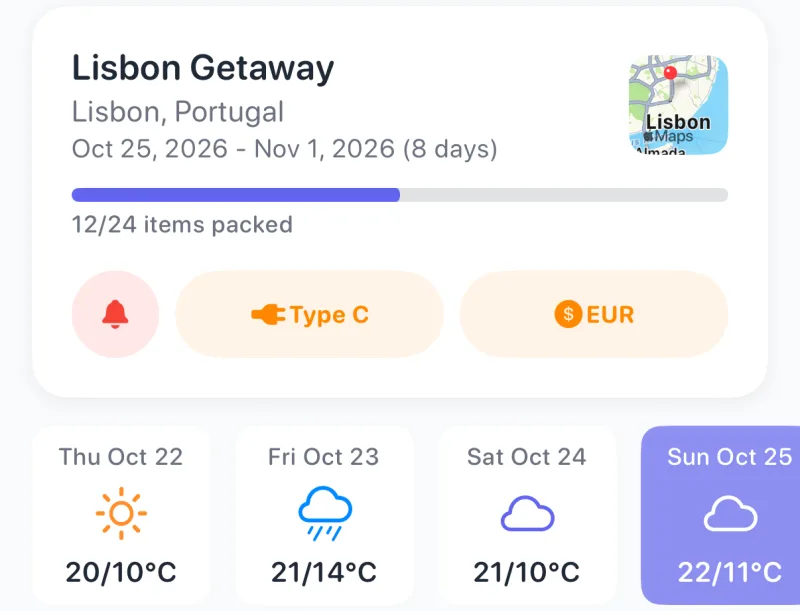
The plug type is one of those things you look up once, forget, and then remember at the airport. Luggy puts it on the trip itself. When you create a trip and pick the destination, the trip screen shows that country's plug type next to its currency, with a weather forecast once your dates are close.
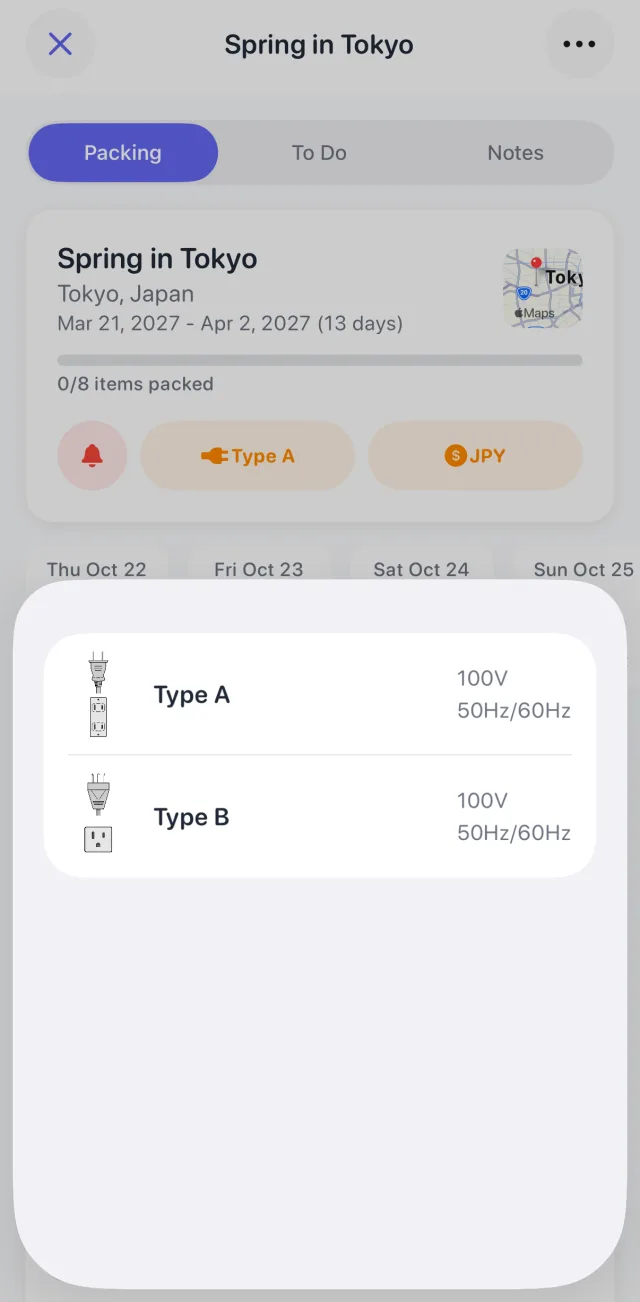
Tap the plug and you get every plug type the country uses, with its voltage and frequency.
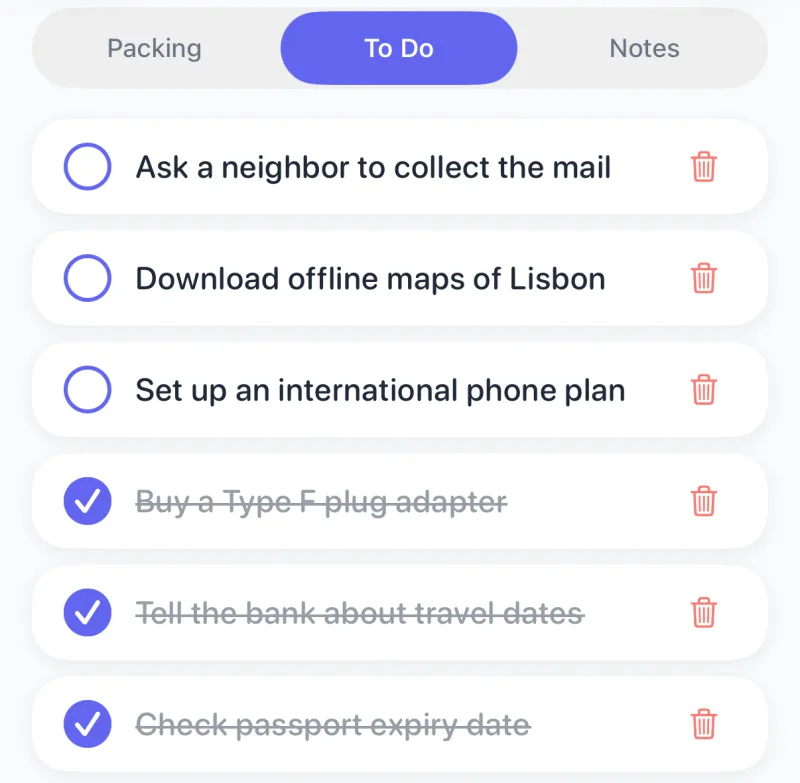
Then put the adapter on the packing list, in Electronics, and buying it on the trip's to-do list, so you can tick off both before you leave.
Luggy is free to download and the free version covers one trip at a time. Luggy+ adds unlimited trips, copying a past trip, packing reminders and reusable custom lists.
Luggy: packing list app
Build a packing list for each trip from 250+ ready-made items in 25 categories, check things off as you pack, keep a pre-trip to-do list, and see your destination's plug type, currency and weather. Free to download.

Common questions
What plug do I need for Italy?
Italy uses Types C, F and L at 230V, 50Hz. A Type C (Europlug) adapter fits Italian sockets for phone and laptop chargers.
What plug do I need for the UK and Ireland?
Type G, the three rectangular blades, at 230V, 50Hz. European round-pin adapters do not fit.
What plug do I need for Spain, Germany, Portugal or Greece?
Types C and F at 230V, 50Hz. One Type C or F adapter covers all four.
What plug do I need for Japan?
Types A and B at 100V, the same basic shape as US plugs. US plugs with one wider pin often do not fit Japanese sockets, so a small adapter is worth packing.
Do I need a travel adapter for Mexico or Canada?
No, if you are coming from the US. Both use Types A and B, at 127V in Mexico and 120V in Canada.
Do I need a voltage converter for Europe?
Not for chargers marked "100-240V", which covers most phones, tablets and laptops. You need one only for single-voltage devices made for 110 to 120V, such as some hair dryers.