Carry-On Packing List for a Week (One Bag, 7 Days)
A week in one carry-on works when you pack for about four days and plan to do laundry once. Wear your bulkiest clothes on the plane, keep liquids in one small bag, and put everything you need during the flight (documents, medicines, chargers, power bank) in your personal item under the seat.
The short version: in the carry-on go 4 tops, 2 bottoms, 4 sets of underwear and socks, sleepwear, a warm layer, one extra pair of shoes at most, toiletries and a laundry bag. In the personal item go your passport or ID, wallet, phone, charger, power bank, medicines, headphones and the liquids bag. On the plane you wear your heaviest shoes, jeans and jacket. Then check your airline's size and weight limits for both bags before you leave.
Check your airline first. There is no single carry-on size. Each airline sets its own size and weight limits for the cabin bag and the personal item, and they can differ by fare type. The UK government's hand luggage guide says it plainly: check with your airline how many and what size bags you can take on the plane. Look up your fare on the airline's own website before you buy a bag or start packing, and check again before you fly, because rules change.
Carry-on vs personal item: what goes where
Airlines often let you bring two bags into the cabin: a carry-on for the overhead bin and a smaller personal item, like a backpack or tote, that goes under the seat in front of you. Not every fare includes both, so check what yours includes.
The rule of thumb: the carry-on holds what you need at your destination, the personal item holds what you need during the trip itself. If your carry-on has to be checked at the gate because the overhead bins are full, everything important is still with you.
| Bag | What goes in it |
|---|---|
| Carry-on | Clothes, shoes, toiletries, laundry bag |
| Personal item | Documents, medicines, electronics, liquids bag |
| On you | Heaviest shoes, jeans, jacket |
The carry-on packing list for a week
Clothes (in the carry-on)
- Tops: 4 (T-shirts or shirts that go with both bottoms)
- Bottoms: 2, one of them worn on the plane
- Underwear: 4
- Socks: 4 pairs
- Sleepwear: 1
- A warm layer: sweater or fleece
- A light rain jacket, worn or packed on top
- One outfit for a nice dinner, if you need it: pick pieces that also work with the rest
- Swimwear, if there is any chance of a pool or beach
Shoes
- Walking shoes, worn on the plane
- One other pair at most (sandals or flat shoes pack small)
Toiletries (in the carry-on, liquids bag in the personal item)
- Toothbrush and toothpaste
- Deodorant
- Razor
- Hairbrush or comb
- Skincare, sunscreen and any makeup, in travel sizes
- Shampoo and conditioner, or buy them there or use the hotel's
Laundry kit (in the carry-on)
- A laundry bag for worn clothes
- A few laundry detergent sheets or a small bar of soap, if you plan to wash in the sink
Personal item
- Passport or ID, boarding pass, wallet and cards
- Phone, charger and cable
- Power bank
- Headphones
- Medicines, in their original containers
- Glasses or contact lenses
- The liquids bag, so you can take it out quickly at security
- An empty water bottle to fill after security
- A plug adapter, if you are going abroad
For trips abroad, our international travel packing list covers the documents and health items in more detail, and our guide to which plug you need tells you which adapter to bring.
How to fit a week of clothes in one bag
Pack for four days, not seven. Plan one laundry stop midweek: a hotel laundry service, a laundromat, a washing machine in a rental apartment, or the sink. Four sets of underwear and socks, plus the set you are wearing, last until laundry day and then for the rest of the week.
Wear the bulkiest items. Jeans, your heaviest shoes, your warmest layer and your jacket go on your body, not in the bag. A jacket with pockets can hold your phone, passport and headphones through security and boarding.
Pick one color palette. If every top goes with both bottoms, four tops and two bottoms make eight outfits. Neutral colors with one or two brighter pieces work for most trips.
Limit shoes. Shoes take more space than anything else. Wear one pair, pack one at most, and fill the packed pair with socks or chargers.
Use packing cubes or roll your clothes. Cubes keep a full bag organized, so you can find things without unpacking everything. Rolled T-shirts and underwear fill the gaps around shoes.
Leave a little room. A bag packed to the zipper on the way out will not close on the way home if you buy anything.
The rules for liquids, medicines and batteries
These are the security rules that most often catch people out with carry-on only. Rules can change, and they differ by country, so check them again close to your trip.
Liquids
In the US, TSA allows a quart-sized bag of liquids, aerosols, gels, creams and pastes in your carry-on, in travel-sized containers of 3.4 ounces (100 milliliters) or less per item. This is the rule often called 3-1-1. TSA says that putting the items in the small bag and separating it from your carry-on makes screening easier, which is why the liquids bag goes in your personal item, near the top. Anything bigger goes in checked baggage, so with carry-on only, buy travel sizes or buy it at your destination.
In the UK, at most airports you cannot take liquids in containers larger than 100ml through security, and where a bag is needed it is a single, transparent, resealable bag that holds no more than a litre and measures about 20cm x 20cm, one per person. Some UK airports now allow containers up to 2 litres, so the guide tells you to check the rules at your departure airport, any connecting airport and for your return journey.
Solid toiletries, like bar soap, solid deodorant and shampoo bars, are an easy way to free up space in the liquids bag.
Medicines
TSA lists medication in pill or other solid form as allowed in carry-on bags. For liquids, it allows larger amounts of medically necessary liquids, gels and aerosols in reasonable quantities for your flight, but you must declare them to the officers at the checkpoint, and clearly labeling your medication helps the screening. In the UK, containers up to 2 litres for essential medical purposes are allowed at all airports.
Keep medicines in your personal item, not the carry-on, so they stay with you if the bigger bag is checked at the gate. If you are flying abroad, our before traveling checklist covers prescriptions and refills.
Power banks and spare batteries
Power banks go in your carry-on or personal item, never in checked luggage. TSA says portable chargers and power banks with a lithium ion battery must be packed in carry-on bags. The FAA's rules for lithium batteries add the details:
- Spare lithium batteries, including power banks and phone battery charging cases, must be carried in carry-on baggage only.
- If your carry-on is checked at the gate or at the plane, you must take all spare lithium batteries and power banks out of it and keep them with you in the cabin.
- The battery terminals must be protected from short circuit, for example in their original packaging or a protective pouch.
- Lithium ion batteries are limited to 100 watt hours each. With airline approval, you can bring up to two larger spares of 101 to 160 watt hours.
Airlines can set their own extra limits on power banks, such as how many you can bring or whether you can use them on board, so check your airline's page too. The gate check rule is one more reason to keep the power bank in the personal item.
Disposable razors are allowed in carry-on bags in the US. For anything else you are unsure about, TSA's What Can I Bring? search lists items one by one, and it notes that the final decision rests with the TSA officer at the checkpoint.
Keep the list in Luggy
Luggy is a packing list app for iPhone. Each trip has a packing list grouped by category, which you build from a ready-made list of 258 items in 25 categories or with your own items. You set a quantity for each item, so "Underwear: 4" is on the list as a number, not a guess, and you check items off as they go into the bag.
Luggy does not have separate bags inside a trip: a trip has one packing list, grouped by category. With Luggy+, you can create your own categories, so the simplest way to split the bags is a custom "Personal Item" category at the top of the list, with the built-in categories below it for everything that goes in the carry-on.
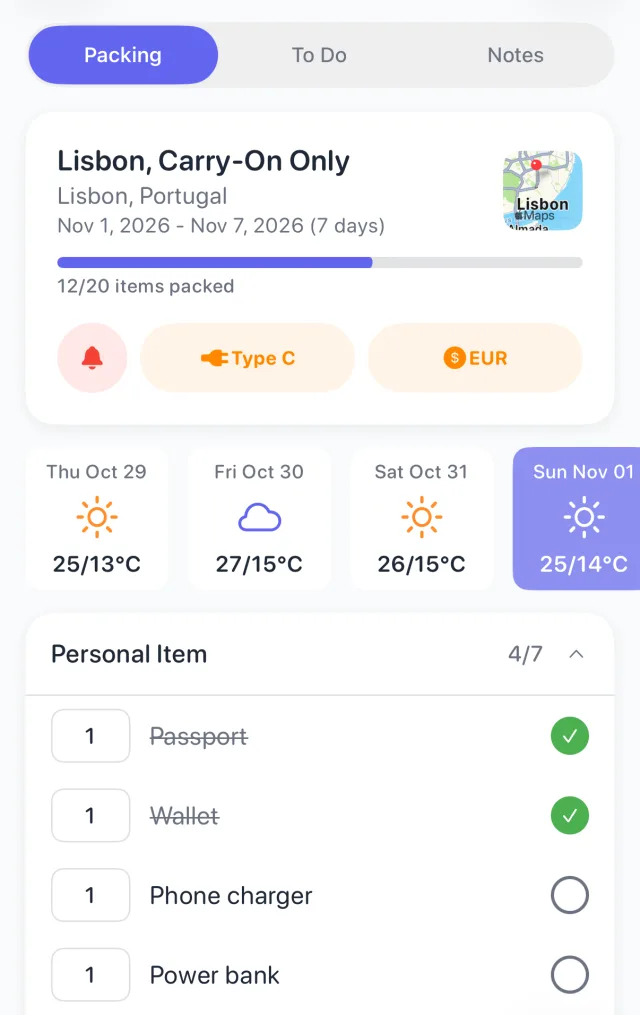
On the free version you cannot add categories, so use a simple rule instead: everything in Documents, Electronics and Health & Safety goes in the personal item, plus the liquids bag, and the rest goes in the carry-on.
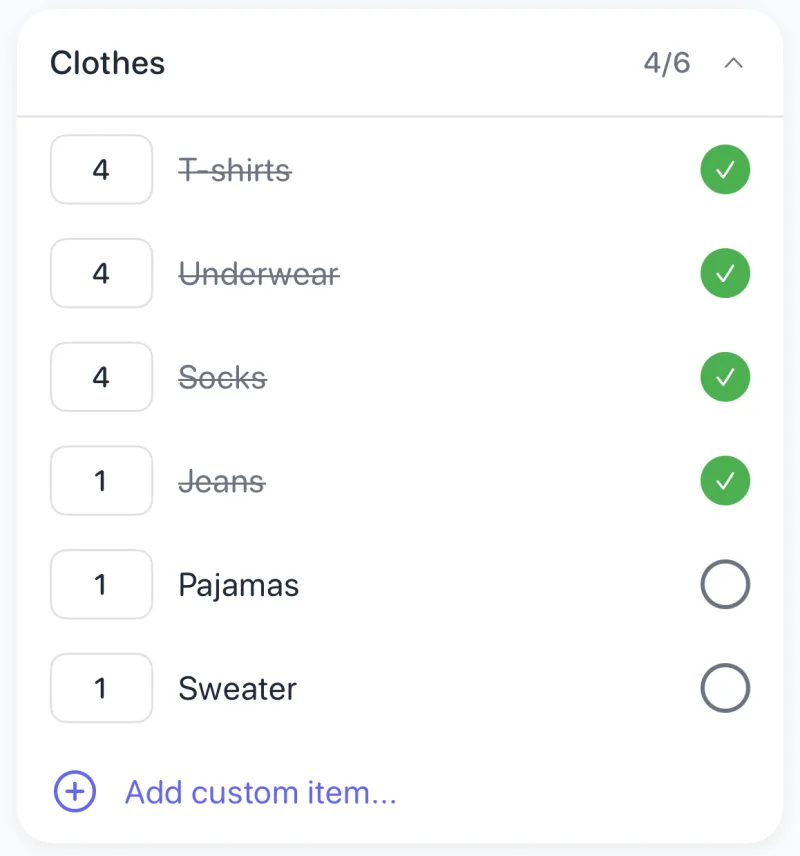
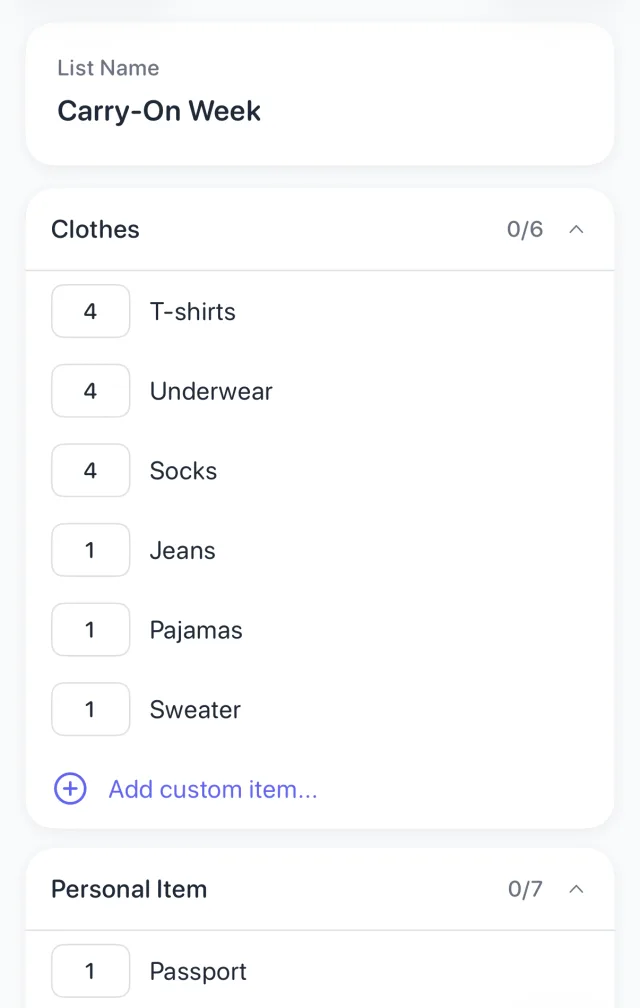
Once your one-bag list works, save it. With Luggy+, a custom list like the "Carry-On Week" list below can be applied to your next trip, so you start from a list that already fits in one bag. Applying a custom list replaces the trip's current items, so apply it first, then add what is specific to that trip.
Luggy is free to download, and the free version covers one trip with the packing list, quantities, check-offs, your own items and a to-do list. Luggy+ adds unlimited trips, custom categories, reusable custom lists, packing reminders and PDF export.
Luggy: packing list app
Build a packing list for each trip from 250+ ready-made items in 25 categories, check things off as you pack, keep a pre-trip to-do list, and see your destination's plug type, currency and weather. Free to download.

The final check before you leave
- Check your airline's size and weight limits for your fare, for both the carry-on and the personal item.
- Liquids: every container 3.4 ounces (100 ml) or less, all in one bag, in the personal item. Outside the US, check the rules at your departure airport.
- Power bank and spare batteries in your personal item rather than the overhead bag, in case that bag is gate checked.
- Medicines in your personal item, in their original containers.
- Documents: passport or ID, boarding pass, cards.
- Wear the bulky things: jacket, jeans, heaviest shoes.
- Try closing the bag and lift it to shoulder height, the way you will at the overhead bin. If it is a struggle now, it will be at the airport.
- Walk through the house for the things still in use: chargers in the wall, toothbrush, glasses. Our list of commonly forgotten items has the full routine.
Common questions
What should I pack in a carry-on for a week?
About four days of clothes (4 tops, 2 bottoms, 4 sets of underwear and socks), sleepwear, a warm layer, one extra pair of shoes at most, travel-size toiletries and a laundry bag, plus a personal item with your documents, medicines, electronics and liquids bag. Wear your bulkiest clothes and shoes on the plane, and plan to do laundry once.
What is the size limit for a carry-on?
There is no single limit. Each airline sets its own size and weight limits for the carry-on and the personal item, and they can depend on your fare. Check your airline's website for your booking before you pack.
What goes in the personal item vs the carry-on?
The personal item holds what you need during the flight and cannot lose: passport or ID, wallet, medicines, phone, charger, power bank, headphones and the liquids bag. The carry-on holds clothes, shoes and toiletries for your stay.
Can I bring a power bank in my carry-on?
Yes, and it must go in the cabin. The FAA says spare lithium batteries, including power banks, must be carried in carry-on baggage only, and taken out of a bag that is checked at the gate. Airlines can add their own limits, so check your airline too.